
How to get a band 7+ in IELTS speaking?
The IELTS Speaking test is a unique challenge that requires more than just general English proficiency; it demands a high degree of structural precision and tactical delivery. To achieve a Band 7.0 or higher, candidates must transition from casual conversation to a performance that aligns with the specific assessment criteria used byIELTS examiners.
In this guide, we’ll help you navigate the IELTS speaking test and perform with total confidence. You will learn to:
Master the A-R-E-C Formula to provide the structured, extended responses required for higher bands
Use Mind Maps to dominate Part 2 and maintain fluency without relying on scripted notes
Leverage Speechful’s AI IELTS Grader to identify and correct the errors that often separate a Band 6.5 from an elite score
1. The Strategy: The A-R-E-C Formula
To reach band 7 or up, we use the A-R-E-C Formula to ensure every answer is substantial:
A – Answer: State your position directly.
R – Reason: Explain your position.
E – Example: Add a personal detail or a concrete fact.
C – Counter (Optional): Acknowledge the other side of the argument.
Pro Tip: Only use counters if you have already secured your first three. If you are struggling for time or word count, a solid A-R-E is better than a rushed, confusing A-R-E-C. Use it when the question asks "To what extent", "Discuss both views" or “Do you agree”.
2. Part 2 Strategy: Visual Brainstorming with Mind Maps
In Part 2, you have exactly 60 seconds to prepare. Most students waste this time writing full sentences. Higher band candidates use a Mind Map.
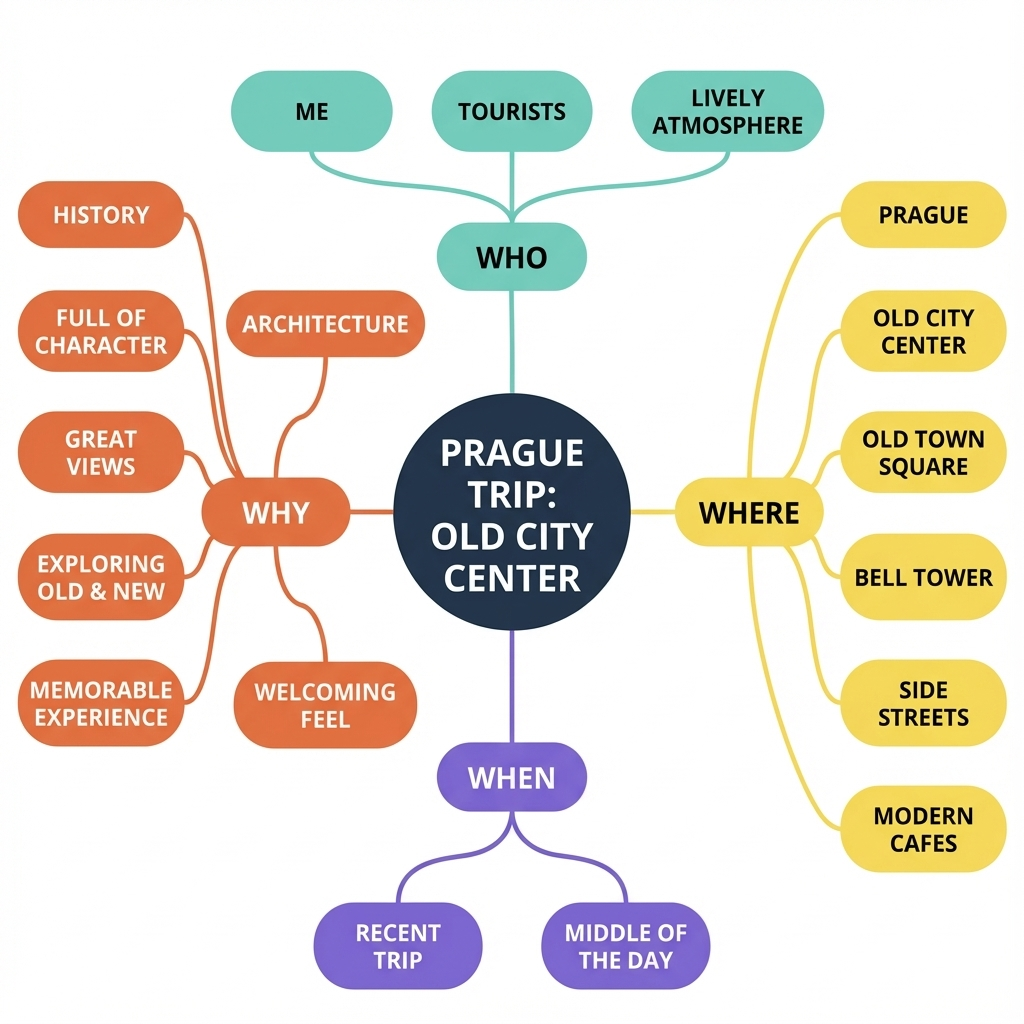
A mind map allows you to organize your thoughts visually. By placing the primary topic from the cue card in the center and branching out, you can quickly build a mental map of your response.
How to Build Your Map:
The Core: Write the main subject in the center of your page.
Use Question Prompts: Create branches using words like Who, Where, When, and Why. This ensures you cover all the necessary details and prevents you from running out of things to say.
Vocabulary Key Words: Instead of full sentences, write down key words you want to mention in your speech (e.g., "Full of character", "Stunning architecture").
3. Putting It Into Practice: Annotated Samples
Based on an actual IELTS mock test on Speechful.ai, here is how a Band 7+ candidate applies the formula across different parts of the test.
Part 1: The A-R-E-C Formula for "Small Talk"
Sample question 1: Who do you spend most time studying or working with?
(A)nswer: At the moment, I collaborate closely with a small team of developers at my office.
(R)eason: We’ve become a very close-knit group of friends over the last year, which makes even the most demanding schedules much easier to handle.
(E)xample: For instance, we usually grab lunch together every Friday to catch up on things outside of our professional projects.
Why This Wins:
Word Choice: Used "close-knit group" and "demanding schedules." These are high-level collocations that sound more professional and precise than the basic alternatives.
The Flow: Used "which makes" to glue the reason to the answer.
Grammar: Used "We’ve become" (Present Perfect) to show change over time.
Sample question 2: What kinds of things do you study or work on with other people?
(A)nswer: Most of my work involves brainstorming new software features and trying to pick up new skills from my more senior colleagues.
(R)eason: I find that working with others is challenging but rewarding, as it allows us to combine our strengths to solve complex problems.
(E)xample: Just last week, for example, we worked together to stay on top of a tight deadline for a client’s app launch.
Why This Wins:
Word Choice: Used "pick up new skills" and "stay on top of a deadline."
The Flow: Used "Just last week, for example" to signal a story.
Grammar: Used "working with others is..." (Gerund) to turn an action into a topic.
Q3: Is it important to like the people you study or work with?
(A)nswer: I’d say it’s absolutely vital for maintaining a healthy work-life balance.
(R)eason: Having a welcoming feel in the office is great for development; if you don't get along with your team, the daily routine can feel a bit repetitive.
(E)xample: In my experience, when there is a positive vibe, people are much more willing to help each other out.
(C)ounter: However, some might argue that an overly social or relaxed environment can occasionally lead to distractions, making it difficult for employees to focus on deep work or meet tight deadlines if the professional boundaries become too blurred.
Why This Wins:
Word Choice: Used "welcoming feel" and "a bit repetitive."
The Flow: Used "In my experience" to move to a personal thought.
Grammar: Used an "If" sentence to show cause and effect.
Part 2: The 2-Minute Long Turn
Cue card: Describe a tourist attraction you enjoyed visiting.
"I’d like to talk about a recent trip I took to the old city center of Prague. I’d wanted to visit for ages because it’s so well-known for its history and stunning architecture.
When I first arrived at the Old Town Square, I was immediately struck by how the area is just full of character. Even though it was the middle of the day and there was quite a lively atmosphere with all the tourists, it didn't feel overwhelming.
One of the highlights was climbing the Bell Tower. It’s an impressive height, and once I reached the observation deck, I was met with great views across the city skyline. Seeing the red-tiled roofs and the river from that perspective was really fascinating.
I enjoyed the visit so much because I get a lot out of exploring places that have a mix of the old and the new. While the history is everywhere, there are also plenty of modern and up-to-date cafes tucked away in the side streets. At the end of the day, it was the welcoming feel of the city that made the experience so memorable for me."
Why This Wins:
Word Choice: Used "stunning architecture" and "lively atmosphere."
The Flow: Used "When I first arrived" to guide the listener like a map.
Grammar: Used "I'd wanted to visit" (Past Perfect) to show background desire.
Part 3: The Two-Way Discussion
Sample question: Do you agree that national museums and galleries should be free to visit?
(A)nswer: I’d say that making cultural institutions free is a brilliant idea for society.
(R)eason: A lot of it comes down to accessibility; when there’s no entry fee, a lot of people tend to visit more often, which is great for the development of local knowledge.
(E)xample: To give you an idea, in London, most major museums are free, and they are always bustling with students and families.
(C)ounter: On the other hand, some argue that without ticket revenue, these institutions may struggle to fund essential maintenance, high-quality temporary exhibitions, or the acquisition of new artifacts, potentially leading to a decline in the quality of the visitor experience over time.
Why This Wins:
Word Choice: Used "bustling" and "accessibility."
The Flow: Used "A lot of it comes down to" and "To give you an idea" to transition into expert analysis.
Grammar: Used "Making... free is..." to turn an idea into a subject.
4. Next Steps: Use Speechful AI as your virtual IELTS grader
Self-correction is difficult because you can't hear your own mistakes. Speechful AI acts as a 24/7 IELTS grader, providing instant feedback on your fluency, grammar, and pronunciation."
1. Audit Your A-R-E-C Structure
Start a Speechful Practice Mode and focus exclusively on the “R” and "E" in A-R-E-C. Review your own answer against the AI’s suggested answer to get ideas on how to improve.
Evaluate your answer using A-R-E-C check on Speechful.ai
2. Practice Your Vocabulary
High-scoring candidates don't just use "big words"—they focus on natural, appropriate language, not big words, by using correct collocations and idiomatic expressions, which sound more authentic and demonstrate a better grasp of English than forced complex vocabulary. Use the Skill Booster to practice and improve your vocabulary.
Use Speechful’s Skill Booster to boost your vocabulary.
3. Master Your Pronunciation
Hesitation often comes from a lack of confidence in specific sounds. If a word is highlighted in yellow on your report, click it to hear the native pronunciation, then repeat after the recording.
Master your pronunciation with Speechful’s pronunciation function.
4. Introduce grammatical range
Most students stay in the "Safe Zone" of basic tenses. Try to use one Past Perfect ("I had wanted to...") or one Conditional ("If they were to...") in every session. Speechful will track your range automatically and run specific exercises on Skill Booster to help you improve.
Ready to improve your current Band score with an AI IELTS grader? Start your mock test on Speechful.ai now.
